---
title: Cost-Effective Flutter Testing | Stratos Aircraft Success with enDAQ
description: Stratos Aircraft achieved cost-effective flutter testing using enDAQ's wireless sensors, ensuring safety and objectivity while clearing their aircraft's flight envelope without traditional expenses.
image: https://info.endaq.com/hubfs/enDAQ-Case-Study-Stratos-Aircraft.jpeg
---
[](https://endaq.com/)
- [Products](https://endaq.com/collections/endaq-shock-recorders-vibration-data-logger-sensors)
Products menu
- [All Data Loggers](https://endaq.com/collections/endaq-shock-recorders-vibration-data-logger-sensors)
- [Data Loggers: Standard](https://endaq.com/collections/endaq-shock-recorders-vibration-data-logger-sensors?_=pf&pf_t_series_type=Series%20Type__S3&pf_t_series_type=Series%20Type__S4)
- [Data Loggers: Large Battery](https://endaq.com/collections/endaq-shock-recorders-vibration-data-logger-sensors?_=pf&pf_t_series_type=Series%20Type__S5)
- [Data Loggers: Wi-Fi Enabled](https://endaq.com/collections/endaq-shock-recorders-vibration-data-logger-sensors?_=pf&pf_t_series_type=Series%20Type__W8&pf_t_series_type=Series%20Type__W5)
- [Mounting Kit](https://endaq.com/collections/endaq-accessories-for-sensor-protection)
- [Pelican Cases](https://endaq.com/collections/endaq-accessories-for-sensor-protection)
- [Water-Proof Enclosures](https://endaq.com/collections/endaq-accessories-for-sensor-protection)
- [Re-Calibrations](https://endaq.com/products/re-calibration-service)
- [Data Services](https://endaq.com/pages/optimize-overall-equipment-effectiveness-endaq-data-services)
Data Services menu
- [Re-Calibration](https://endaq.com/products/re-calibration-service)
- [NEW - Data Services](https://endaq.com/pages/optimize-overall-equipment-effectiveness-endaq-data-services)
- [Software](https://endaq.com/pages/data-analysis-software)
Software menu
- [Software Overview](https://endaq.com/pages/data-analysis-software)
- [LAB Configuration](https://endaq.com/pages/vibration-shock-analysis-software-endaq-slam-stick-lab)
- [Cloud Analysis](https://endaq.com/collections/endaq-data-cloud-platform)
- [Open Source Libraries](https://endaq.com/pages/endaq-open-source-python-library-for-shock-vibration-analysis)
- [Applications](https://endaq.com/pages/shock-vibration-environmental-sensor-applications)
Applications menu
- [All Applications](https://endaq.com/pages/shock-vibration-environmental-sensor-applications)
- [Vibration](https://endaq.com/pages/vibration-sensors-and-vibration-loggers-for-data-acquisition)
- [Shock & Impact](https://endaq.com/pages/shock-impact-sensors-and-recorders-resources)
- [Machine Learning](https://endaq.com/pages/training-machine-learning-models-with-vibration-data)
- [Environmental](https://endaq.com/pages/environmental-sensors-for-data-acquisition)
- [High Value Asset Monitoring](https://endaq.com/pages/shock-vibration-sensors-for-shipping-monitoring)
- [Wireless Monitoring](https://endaq.com/pages/wireless-vibration-monitoring-systems)
- [Resources](https://endaq.com/pages/shock-vibration-resources-center)
Resources menu
- [All Resources](https://endaq.com/pages/shock-vibration-resources-center)
- [Application Areas](https://endaq.com/pages/shock-vibration-environmental-sensor-applications)
- [Battery Life Estimator](https://endaq.com/pages/data-logger-battery-life-estimator)
- [Case Studies](https://endaq.com/pages/case-studies)
- [Free Datasets](https://endaq.com/pages/real-shock-vibration-tests-and-data)
- [Cheat Sheets](https://endaq.com/pages/cheat-sheets-vibration-shock-condition-based-monitoring)
- [Handbooks](https://endaq.com/pages/handbooks)
- [Video Tutorials](https://endaq.com/pages/shock-and-vibration-analysis-video-tutorials)
- [Webinars](https://endaq.com/pages/webinars)
- [Blog](https://blog.endaq.com/?hsLang=en)
Blog menu
- [Vibration Analysis: FFT, PSD, & Spectrogram](https://blog.endaq.com/vibration-analysis-fft-psd-and-spectrogram?hsLang=en)
- [Top 12 Vibration Metrics to Monitor](https://blog.endaq.com/top-vibration-metrics-to-monitor-how-to-calculate-them?hsLang=en)
- [6 Ways to Measure Vibration](https://blog.endaq.com/6-ways-to-measure-vibrations?hsLang=en)
- [Shock Analysis: Response Spectrum (SRS)](https://blog.endaq.com/shock-analysis-response-spectrum-srs-pseudo-velocity-severity?hsLang=en)
- [Accelerometer Selection: Take out the Guesswork](https://blog.endaq.com/accelerometer-selection?hsLang=en)
- [...All Blog Posts](https://blog.endaq.com/?hsLang=en)
- [Help Center](https://support.endaq.com/)
- [Contact](https://endaq.com/pages/contact)
Search
[Cart](https://endaq.com/cart)
Menu
Search enDAQ
Search
Aerospace & Aviation Case Study
# **How E/AB Teams Can Perform Cost-Effective, Objective, and Safe Flutter Tests with enDAQ's Wireless Accelerometers**
This case study describes how Stratos Aircraft used enDAQ wireless accelerometers to conduct objective flutter envelope clearance testing on their Proof of Concept jet—replacing subjective pilot-perception methods with reliable, distributed sensor data at a fraction of the cost of traditional approaches.
Impact at a glance
Successful PoC Flight Envelope Clearance
Using enDAQ distributed wireless sensors, Stratos Aircraft confirmed no flutter trends in their Proof of Concept aircraft, achieving full flight envelope clearance with an affordable, non-invasive sensor approach—enabling their path to commercial certification.
Stratos Aircraft · enDAQ W8-E25D40 (customized)
Executive Summary
## How Stratos Aircraft cleared a transonic flight envelope without breaking the budget
Flutter testing is a safety-critical requirement for any new aircraft program. For large aerospace manufacturers, the cost is manageable. For aviation startups like Stratos Aircraft, standard flutter testing methods can be prohibitively expensive. enDAQ's wireless, self-contained sensors enabled Stratos to take a novel, objective approach—distributing sensors across their PoC airframe to capture bending and torsional modes during both ground and in-flight testing.
Challenge
**Cost-Prohibitive Standard Testing** — Traditional flutter testing was too expensive for a startup. Pilot-perception methods were deemed too risky and subjective for a complex transonic flight envelope clearance.
Solution
**Distributed Wireless Sensing** Customized enDAQ W8-E25D40 wireless sensors were mounted at discrete locations on the airframe. GPS-enabled time synchronization allowed differentiation of symmetric and antisymmetric wing modes.
Results
**Envelope Cleared. Data Published.**
— No flutter trends were found in the PoC aircraft data. Testing revealed valuable excitation characteristics for stick/pedal raps and airbrakes, informing future E/AB testing standards.
[](https://cta-redirect.hubspot.com/cta/redirect/637862/707ed356-839c-4f02-a429-2e8baca16477)
---
The Challenge
## Flutter testing is essential—but standard approaches were out of reach
Flutter is a self-excited vibration caused by the interaction of aerodynamic, inertial, and elastic forces acting on an aircraft wing. If not designed for and validated through testing, flutter can lead to catastrophic structural failure. Every new aircraft program must address flutter—both on the ground and in flight.
For Stratos Aircraft, a jet manufacturer from Redmond, Oregon developing an Experimental-designated single-engine transonic jet, the standard approach to flutter testing was financially prohibitive. To compensate for smaller budgets, many Experimental/Amateur-Built (E/AB) aircraft manufacturers fall back on pilot perception of stick and rudder pedal raps—a method Stratos deemed too risky and too subjective for their complex transonic flight envelope.
- Standard flutter certification testing is cost-prohibitive for aviation startups.
- Pilot-perception methods are subjective and do not produce objective, repeatable data.
- The flight envelope included transonic speeds, increasing the complexity and risk of flutter events.
- Any sensor solution needed to avoid altering aircraft mass or structural properties.
---
The Solution
## Distributed wireless sensors across the airframe—no wiring, no mass impact
enDAQ provided customized wireless sensors based on the W8-E25D40 platform. The customization allowed the devices to be affixed to the aircraft without altering mass or structure—a critical requirement for valid flutter testing. Stratos mounted the sensors at discrete locations on the PoC airframe, enabling simultaneous monitoring of the wing's main bending and torsional modes.
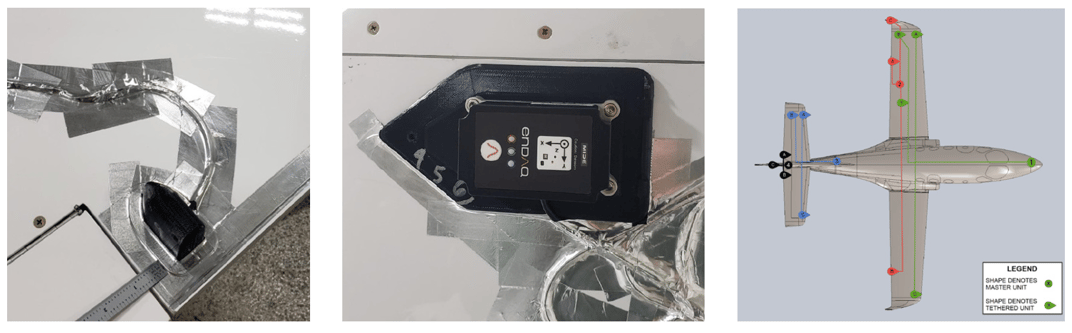*enDAQ accelerometer in-situ set-up and diagram of placement on body of aircraft.*
---
With onboard GPS and wireless capabilities, the sensors generated timestamped data that allowed exact synchronization across all devices. This synchronization was crucial to differentiating between symmetric and antisymmetric motion—a key requirement for flutter envelope clearance.
To excite the PoC aircraft's structure, pilots conducted stick and pedal raps with a dead blow hammer, stomped on the pedals, and deployed airspeed brakes during flight. The resulting data revealed the frequency content of each excitation type across different altitudes and airspeeds.
- Stick and pedal raps excited structural modes up to 15 Hz—higher than previously expected.
- Airbrake deployment produced broadband excitation of the entire airframe from 15 to 40 Hz.
- GPS-based time synchronization enabled symmetric vs. antisymmetric mode differentiation.
- Pressure transducer data provided altitude synchronization across sensor devices.
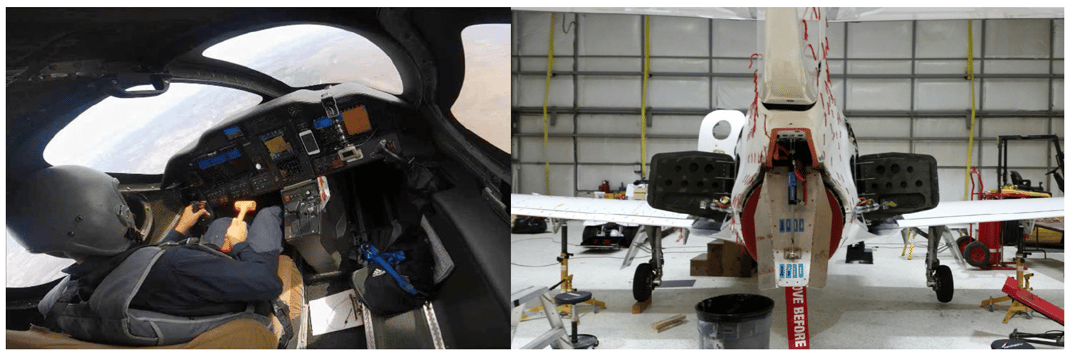*Left: Pilot performing stick and pedal rap testing with a dead blow hammer. Right: Air brakes deployed on PoC aircraft.*
---
Results
## Flutter-free envelope clearance—and a new framework for E/AB testing
Successful flight envelope clearance of Stratos PoC aircraft — no flutter trends identified
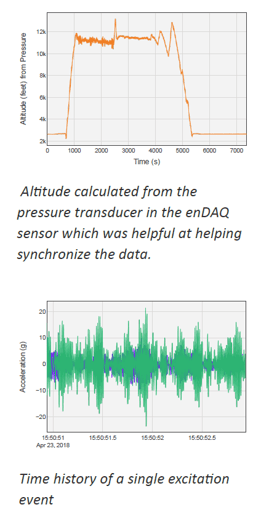The data collected by enDAQ's distributed sensors confirmed no trends indicative of flutter within the PoC aircraft testing data, leading to successful flight envelope clearance. The testing also produced insights of broader value to the E/AB aircraft community.
Stick and pedal rap frequency response (up to 15 Hz) proved more valuable for flutter testing than previously thought, while airbrake deployment was highly effective at exciting the 15–40 Hz range across the entire airframe. Both findings were published as part of an AIAA technical article, contributing to the broader body of knowledge on E/AB flutter clearance.
enDAQ's self-contained sensors made this novel approach possible—providing accurate, high-quality data with minimal installation requirements and no interference with the aircraft's structure. Stratos's results indicate that this methodology may serve as an alternate means of flutter clearance for other E/AB manufacturers.
- No flutter trends found across any test condition—full PoC flight envelope cleared.
- Stick/pedal rap excitation proven effective up to 15 Hz for flutter testing purposes.
- Airbrake excitation covered 15–40 Hz, complementing stick/pedal rap data.
- Findings published in an AIAA peer-reviewed technical article.
- Approach validated as a cost-effective alternative for E/AB flutter clearance programs.
---
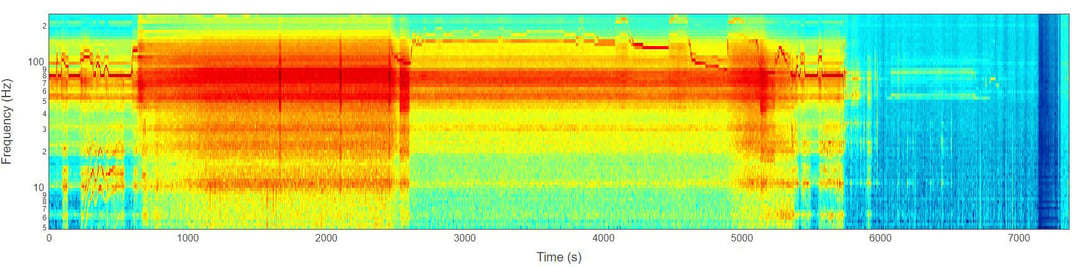
*Spectrogram of the full acceleration time history of a test flight.*
---
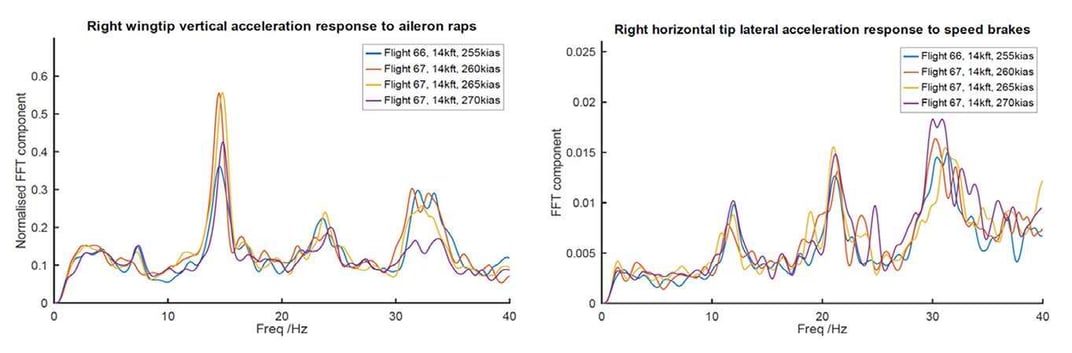
*Spectra of excitation events at different altitude and speeds to determine if a flutter resonance is developing.*
---
[](https://info.endaq.com/hs/cta/wi/redirect?encryptedPayload=AVxigLJsuBstkAA1Kaj5SanBZPl%2FR7N1EKzR4eTxy43Tt1Re0yLBPlrx5WbtO0KsieAEVkodVHebJCZQoidMO7vQUuvlyVXkXEAoWv8zvDTPPy2wMAxy28729zbJWCX8EwYwZ7q0fF1d8DA5DK%2FFy0MYTunDkt06JsnMNmpfOuPKYZRkyQxa6XzMzwCyqhrL&webInteractiveContentId=192720055314&portalId=637862&hsLang=en)
---
Comparison of Flutter Testing Approaches
| Aspect | Standard Flutter Testing | enDAQ Wireless Sensor Approach |
| --- | --- | --- |
| Cost | Prohibitively expensive for startups | Affordable — fraction of traditional testing cost |
| Objectivity | Pilot perception methods are subjective | Quantitative, repeatable sensor data |
| Structural Impact | Traditional wired systems require structural modifications | Non-invasive — no mass or structural alteration |
| Synchronization | Complex multi-channel wired DAQ systems | GPS-enabled wireless time synchronization |
| Mode Coverage | Dedicated excitation systems | Stick/pedal raps (up to 15 Hz) + airbrakes (15–40 Hz) |
---
### Frequently Asked Questions
What is flutter and why does it matter for aircraft certification?
Flutter is a self-excited vibration arising from the interaction of aerodynamic, inertial, and elastic forces on an aircraft wing. If it occurs in the operational flight envelope, it can cause rapid structural failure. All aircraft must demonstrate flutter-free operation within their cleared flight envelope before certification.
How did enDAQ sensors avoid affecting the aircraft's flutter characteristics?
The sensors were customized to allow affixing directly to the airframe without adding meaningful mass or altering structural properties. Flutter characteristics are highly sensitive to mass distribution, so this was an essential design requirement for the testing approach.
How were multiple wireless sensors synchronized?
enDAQ's W8-series sensors include GPS capability, enabling time-stamped data that can be precisely synchronized across all deployed units. This was critical for distinguishing symmetric (both wings moving together) from antisymmetric (wings moving in opposition) flutter modes.
Why were airbrakes effective for flutter excitation?
When deployed, airbrakes create a broadband aerodynamic disturbance that excites the entire airframe across a wide frequency range (15–40 Hz in this case). This makes them an effective tool for exciting higher structural modes that stick and pedal raps alone may not reach.
Can this testing approach apply to other E/AB aircraft programs?
Yes. Stratos's successful results suggest that distributed wireless enDAQ sensors, combined with stick/pedal rap and airbrake excitation, may serve as an alternate means of flutter clearance testing for other Experimental/Amateur-Built aircraft manufacturers facing similar budget constraints.
[](https://info.endaq.com/hs/cta/wi/redirect?encryptedPayload=AVxigLJsuBstkAA1Kaj5SanBZPl%2FR7N1EKzR4eTxy43Tt1Re0yLBPlrx5WbtO0KsieAEVkodVHebJCZQoidMO7vQUuvlyVXkXEAoWv8zvDTPPy2wMAxy28729zbJWCX8EwYwZ7q0fF1d8DA5DK%2FFy0MYTunDkt06JsnMNmpfOuPKYZRkyQxa6XzMzwCyqhrL&webInteractiveContentId=192720055314&portalId=637862&hsLang=en)
---
Project Details
Key information for engineers
**Customer:** Stratos Aircraft
**Location:** Redmond, Oregon, USA
**Application:** Aircraft flutter envelope clearance testing
**Primary Product:** enDAQ W8-E25D40 (customized wireless)
- Ground and in-flight testing conducted
- Stick/pedal raps excited modes up to 15 Hz
- Airbrakes covered 15–40 Hz excitation
- GPS-synchronized multi-sensor deployment
- Published in AIAA technical article
enDAQ's self-contained sensors enabled a novel, affordable approach to flutter clearance testing—with no interference with the aircraft structure.
— Stratos Aircraft Case Study
[](https://cta-redirect.hubspot.com/cta/redirect/637862/707ed356-839c-4f02-a429-2e8baca16477)
---
# Book a Demo
### Welcome. Our product engineers are happy to listen & guide you through the best options for your application:
- Which is the best [enDAQ Data Logger](https://endaq.com/collections/endaq-sensors-shock-vibration-s-series) for my application? What are its features, and can I see an analysis example pertinent to my application?
- How can your software, including the [enDAQ Cloud](https://endaq.com/collections/endaq-cloud-remote-vibration-monitoring) help me upload, customize, visualize, and share my data?
[](https://endaq.com/)
[enDAQ.com](https://endaq.com/)
Division of [Mide Technology](https://www.mide.com/?utm_source=endaq-com&utm_medium=text-link&utm_campaign=link-from-endaq-footer&utm_term=endaq&utm_content=link-from-endaq-footer-to-mide)
475 Wildwood Avenue
Woburn, MA 01801
United States
Mide is a [Hutchinson Company](https://www.mide.com/about-mide#hutchinson)
[Resources](https://endaq.com/pages/learn-sensors-data-acquisition-analysis)
- [Help Center](https://support.endaq.com)
- [How to Generate a Quote](https://endaq.com/pages/how-to-generate-a-quote)
- [Application Areas](https://endaq.com/pages/shock-vibration-environmental-sensor-applications)
- [Test Examples with Data](https://endaq.com/pages/real-shock-vibration-tests-and-data)
- [Unit Donation Program](https://info.endaq.com/endaq-vibration-sensor-donation-program?hsLang=en)
- [Blog](https://blog.endaq.com?hsLang=en)
[Products](https://endaq.com/pages/endaq-product-availability-page)
- [Sensors Catalog](https://endaq.com/pages/endaq-product-availability-page)
- [Accessories](https://endaq.com/collections/accessories)
- [Testimonials](https://endaq.com/pages/endaq-customer-reviews-testimonials)
- [Book a Demo](https://info.endaq.com/book-an-endaq-demo?hsLang=en)
- [Services](https://endaq.com/collections/data-acquisition-sensors-analysis-services)
[Why enDAQ?](https://endaq.com/pages/why-endaq)
- [Software](https://endaq.com/pages/data-analysis-software)
- [enDAQ CLOUD](https://endaq.com/collections/endaq-data-cloud-platform)
- [Compare Data Loggers](https://info.endaq.com/vibration-data-logger-comparison-guide?hsLang=en)
-
- [Roadmap](https://endaq.com/pages/platform-roadmap)
[About](https://endaq.com/pages/about)
- [Careers](https://endaq.com/pages/careers)
- [Events](https://endaq.com/pages/endaq-events)
- [Branding Guidelines](https://endaq.com/pages/endaq-branding-guidelines)
- [Contact Us](https://endaq.com/pages/contact)
- [Distributors](https://endaq.com/pages/endaq-find-a-distributor)
- Phone: [+1 781 306-0634](tel:+17813060634)
- [](https://www.linkedin.com/showcase/endaq-sensors/)
- [](https://endaq.com/)
- [ISO Certifications](https://endaq.com/pages/iso-certifications-endaq)
- [FCC Compliance](https://cdn.shopify.com/s/files/1/0086/4891/7097/files/endaq-FCC-SDoC.pdf?v=1769639636)
- [Copyright Policy](https://endaq.com/pages/copyright-policy)
- [Terms & Conditions](https://endaq.com/pages/terms-conditions)
- [Privacy Policy](https://endaq.com/pages/privacy-policy)
- [Shipping & Ordering Policy](https://support.endaq.com/article/123-ordering)
- [Payment Types ](https://endaq.com/pages/terms-conditions#payment)
```json