Accident Reconstruction & Testing Case Study

Determining Bicycle Braking Performance with enDAQ Sensors

This case study describes how Momentum Engineering Corp. used enDAQ sensors to measure and quantify bicycle deceleration across eight different bike types, filling a critical research gap in accident reconstruction and enabling data-driven legal opinions on bicycle crashes.

Executive Summary

How Momentum Engineering Corp. used enDAQ to fill a gap in bicycle crash research

Momentum Engineering Corp. (MEC) identified a lack of comprehensive data surrounding bicycle braking performance. Without reliable, bike-type-specific deceleration data, accident reconstructionists were forced to apply road bicycle figures to BMX or other bicycle crashes—producing inaccurate results. MEC used an enDAQ sensor to conduct controlled brake-to-stop tests across eight different bicycles and publish peer-reviewed findings..

Challenge
 Research Gap in Bicycle Crash Data — There was insufficient data on bicycle braking across different bike types and brake configurations, making accurate accident reconstruction difficult for legal cases. .
Solution
Portable, SAE-J211-Compliant Sensing — An enDAQ S4-E25D40 sensor was attached to eight bicycles to measure deceleration during brake-to-stop tests, with UTC-synchronized video for complete analysis.
Results
Peer-Reviewed, Actionable Findings — MEC quantified deceleration rates for rear-only and combined front-and-rear braking, publishing results in SAE International to support future legal opinions.

Download PDF of Case Study


The Challenge

A critical gap in bicycle crash research data

Nick Famiglietti and his colleagues at Momentum Engineering Corp., a consulting firm specializing in accident reconstruction, identified a significant gap in research surrounding bicycle crashes. As Famiglietti noted, there was not a lot of strong data about bicycle braking.

An accident reconstruction firm may encounter a BMX bicycle crash case but only have data from a road bicycle—providing an incomplete and potentially inaccurate picture of the crash. To accurately determine how fast a bicyclist was traveling at the time of an incident, MEC needed comprehensive braking data across a range of bicycle types.

  • No comprehensive data existed for bicycle braking across different bike designs and applications.
  • Applying road bicycle data to BMX or other crash types yielded inaccurate reconstruction results.
  • A portable, lightweight sensor was required that would not alter the center of gravity of the test bicycle.
  • Data needed to be suitable for publication in a peer-reviewed industry journal to support legal testimony.

enDAQ-Sensors-Case-Study-Momentum-Engineering-Bike-Brake- enDAQ-Sensors-Case-Study-Momentum-Engineering-Bike-Brake
enDAQ S4 sensor mounted track‑side to measure vibration on a high‑traffic set of points on the London Underground.

The Solution

Controlled multi-bike brake testing with an enDAQ sensor

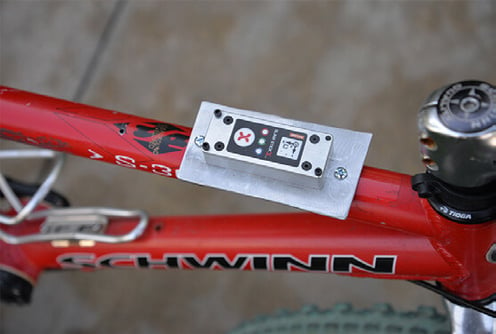
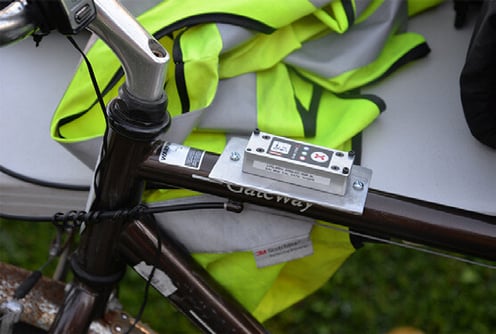
MEC used an enDAQ sensor (S4-E25D40) that satisfies the SAE-J211 standard for vehicle impact testing sensors. The sensor was secured to the top tube of the bicycle frame between the seat and the handlebars—a position that minimized weight addition and had no meaningful effect on center of gravity.

Over three days, MEC conducted three test sessions at different sampling rates: 3,200 Hz on day one, 100 Hz on day two, and 800 Hz on day three. Each test measured the deceleration across two phases: the initial braking phase (lever squeeze and onset of deceleration) and the incipient lock-up phase (skidmark production).

Video was also used to document each brake test. By programming UTC timing on the sensor, the timestamped data was synchronized with the video footage for a thorough and reproducible analysis.
"We like the enDAQ sensor specifically because it's so small... it also has an integrated battery and it's really easy to use."
— Nick Famiglietti, Momentum Engineering Corp.
  • Eight different bicycles tested with a single rider at the same location for consistent conditions.
  • enDAQ sensor begins recording with a push of a button—no laptop connection required per trial.
  • UTC-synchronized timestamps enabled accurate video-data fusion for analysis.
  • SAE-J211 compliance ensured data was accepted for peer-reviewed publication.

enDAQ-Sensors-Case-Study-Momentum-Engineering-Bike-Brake-2


Results

Quantified braking data published in SAE International

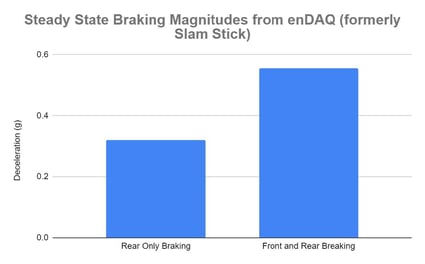
Deceleration rates quantified across 8 bicycles — rear only and combined front + rear braking

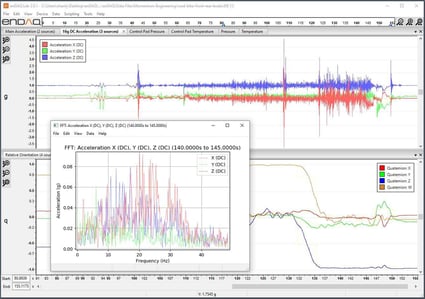
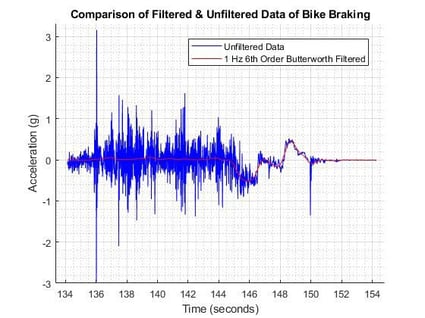
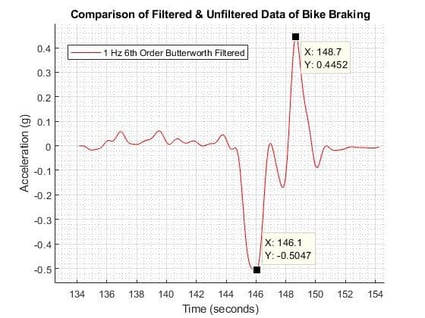
Using the enDAQ sensor, MEC quantified deceleration rates for bikes using rear-only braking and those using both front and rear braking. The 16g DC-response accelerometer captured significant vibration data alongside the deceleration signal. By applying a 1 Hz 6th-order Butterworth low-pass filter in enDAQ Analyzer software, the team isolated only the braking deceleration of interest.

The results demonstrated clear differences between the two brake configurations, with combined front-and-rear braking producing substantially higher steady-state deceleration magnitudes than rear-only braking.

Famiglietti and his team published their findings as a technical paper in SAE International. This peer-reviewed data now allows Momentum Engineering Corp. to provide reliable, defensible legal opinions in cases involving bicycle crashes—across any bike type covered by the study.
 

enDAQ-Sensors-Case-Study-Momentum-Engineering-Bike-Brake-3        enDAQ-Sensors-Case-Study-Momentum-Engineering-Bike-Brake-4  


enDAQ-Sensors-Case-Study-Momentum-Engineering-Bike-Brake-5

"The enDAQ sensor is by far the most affordable unit that satisfies the J211 standard."
— Nick Famiglietti, Momentum Engineering Corp.


  • Steady-state braking deceleration clearly differentiated between brake design categories.
  • Low-pass filter in enDAQ Analyzer software successfully isolated deceleration from vibration noise.
  • Published in SAE International as a peer-reviewed technical paper.
  • Data now serves as an industry reference for bicycle crash accident reconstruction.

Aspect Traditional Crash Testing Units enDAQ S4 Sensor
Size & Weight Larger; risk of affecting bicycle center of gravity Compact and lightweight — no measurable effect on test results
Setup per Trial Requires laptop connection for each recording session Push-button start; integrated battery — no laptop needed
SAE-J211 Compliance Varies by unit Fully compliant — accepted for peer-reviewed publication
Cost High — most J211-compliant units are significantly more expensive Most affordable J211-compliant unit available
Data Synchronization Manual synchronization required UTC timestamp enables automatic video synchronization

Frequently Asked Questions

Why is bicycle-specific braking data important for accident reconstruction?
Different bicycle types and brake configurations produce significantly different deceleration profiles. Using data from the wrong bike type can lead to inaccurate speed calculations and flawed legal conclusions in crash investigations.
What does SAE-J211 compliance mean for a sensor?
SAE-J211 defines the performance requirements for instrumentation used in vehicle impact testing. Compliance ensures the sensor meets industry standards for frequency response, accuracy, and data quality accepted in legal and engineering contexts.
How did MEC isolate the braking signal from vibration noise?
The team applied a 1 Hz 6th-order Butterworth low-pass filter using enDAQ Analyzer software. This filtered out the high-frequency vibration content captured by the accelerometer, leaving only the lower-frequency deceleration data of interest.
How was video synchronized with sensor data?
The enDAQ sensor was programmed with UTC timing, generating timestamped data that could be precisely aligned with video footage of each brake test for a comprehensive, frame-accurate analysis.
Can enDAQ sensors be used for other vehicle accident reconstruction applications?
Yes. enDAQ sensors have been used across a wide range of crash testing and accident reconstruction scenarios, including motorcycle-vehicle collisions, measuring velocity change, peak acceleration, and pulse duration during impact events.

Book a Demo

Welcome. Our product engineers are happy to listen & guide you through the best options for your application:

  • Which is the best enDAQ Data Logger for my application? What are its features, and can I see an analysis example pertinent to my application?

  • How can your software, including the enDAQ Cloud help me upload, customize, visualize, and share my data?

enDAQ-sensors-group-orange-reflection-600x324