Diagnosing Rail Point Failures: Root Cause Vibration Analysis with Portable enDAQ S4 Data Loggers
This case study describes how a UK rail organization used enDAQ S4 vibration data loggers to monitor track and rolling stock vibrations, enabling early‑stage failure identification and helping them protect 10,000+ commuter transport hours per year.
Executive summary
How London Railway Company uses enDAQ to protect aging rail assets
London Rail Company manages a 100-year-old metro system where signaling and track assets face constant structural fatigue. Repeated failures at track points were causing significant service outages. By transitioning from reactive maintenance to an enDAQ-powered Predictive Monitoring strategy, they identified the specific vibration profiles causing mechanical failure.
Challenge
The Challenge: Field-Testing in High-Traffic Zones Engineers needed to identify the root cause of point failures during peak operating hours. Traditional wired DAQ systems were ruled out due to the complexity of track-side wiring and power requirements in a busy underground environment. .
Solution
Adaptable, Cable-Free Sensing
The team deployed enDAQ S4 configurable sensors directly track-side. Because the S4 combines a high-quality piezoelectric accelerometer, power, and memory into one ruggedized package, setup was completed in minutes without external wiring. These sensors captured synchronized vibration and voltage data, providing a high-fidelity look at the points' dynamic response during train passes.
Results
Actionable Data & 10,000 Hours Saved Using the actionable data provided by enDAQ Lab software, engineering teams collaborated to design targeted damping mitigations and localized speed limits. This data-driven approach is projected to save 10,000 Lost Customer Hours annually while providing a scalable framework for protecting aging infrastructure.
THE Challenge
Lost customer hours due to the unplanned downtime of trains being taken out of service
The Signal Engineer from the London Rail Company was faced with a challenge. With a system that still has assets such as track and signaling equipment over 100 years old, breakdowns occur and reactive repairs are to be expected.
The challenge was that, despite the Company's reliability, one of the major threats to efficient service is the failure of points, train stops, and position detectors, which leads to trains being taken out of service and an increase in Lost Customer Hours (LCH). In this instance, faults on points (the movable section of track allowing trains to switch lines) in a section of the London Underground resulted in them being scotched, clipped, and removed from service.
Despite remedial work, there were challenges returning the points to service, with concerns being raised over the cause of fluctuating voltages as trains traversed the points. The engineer was tasked with the short-term goal of returning the “point machines” to service by investigating and proving the root cause of the asset failure was due to high levels of vibration. According to the engineer, “What started this off was that vibration was doing a lot of damage to our equipment.” The long-term goals were to transition away from a reactive maintenance model and develop a spec for manufacturers that would guide equipment designs to accommodate the harsh environment in which the points operate.
Oldest public transport system in the world, with some signaling and track assets over 100 years old.
Failures in points, train stops, and position detectors regularly removed trains from service.
Short‑term goal: prove whether high vibration levels were damaging equipment and causing failures.
Long‑term goal: develop a spec for manufacturers that would guide equipment designs to accommodate the harsh environment in which the points operate.
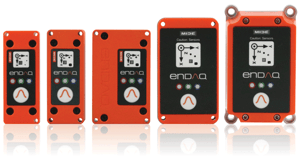
enDAQ S4 sensor mounted track‑side to measure vibration on a high‑traffic set of points on the London Underground.
THE Solution
Configurable enDAQ S4 sensors for track‑side monitoring
To characterize the environment, engineers configured enDAQ S4 sensors off‑site, then handed them to maintenance crews who installed them track‑side during early-morning maintenance windows.
The sensors recorded vibration and related behavior during peak morning traffic, after which crews uploaded the data for engineering analysis.
Deployment and data collection
enDAQ S4 sensors were configured remotely to match the expected vibration environment and duty cycle.
Maintenance teams could quickly mount sensors near the affected points during planned access windows.
Data captured peak‑hour vibration levels and allowed direct comparison before and after mitigations - like speed limits.
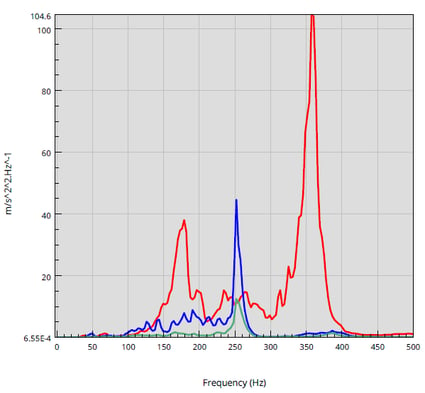
The red trace shows the frequency content of the signal with the trains at full speed. The blue trace is the frequency content immediately after imposing a 40 KPH speed limit (note the frequency shift because of the lower speed) and the green trace is followup monitoring a few months later.
“We’re able to give the sensors to the guys who are going to be on these assets and they can install them. And the beauty is, with a few monitors, we can cover hundreds of miles worth of track and thousands of assets depending on what we decide we want to be monitoring.”
— Signal Engineer, London Railway Company
Cross‑team collaboration
By sharing data across Signal Maintenance, Signal Engineering, Track Maintenance, and Track Engineering, they developed a customized plan to damp vibration and address repeat failures on the problem points.
Frequency‑domain analysis of the data showed how a new 40 KPH speed limit shifted the vibration spectrum and reduced damaging amplitudes through the points.
Results
Fewer failures, lower Lost Customer Hours, and a path to condition‑based monitoring
10,000+ Lost Customer Hours saved on a single asset
Prior to the enDAQ deployment, one high‑traffic set of points experienced multiple failures, with around 10,000 Lost Customer Hours attributed to that asset alone.
After implementing a speed limit and vibration‑damping measures, and validating their effect with enDAQ sensors, the London Rail Company reported no further failures on that asset.
Clear link established between high vibration levels, fluctuating voltages, and point failures.
Data‑driven justification for operational changes such as speed limits on critical sections.
Improved ability to distinguish “normal” vs. concerning vibration levels across assets.
Foundation laid for condition‑based monitoring and updated equipment specifications to handle known vibration environments.
“Using the enDAQ Sensors, we could see that while improvements had been made, the vibrations seen through the points had not been fully eradicated. With the help of Track Engineering, Signals Engineering, Point Care and the Line Signals and Track teams, we were able to analyze the data and tailor the solution to damp the vibration levels to an acceptable level which resolved the repeated failures.”
— BCV Signal Manager, London Rail Company
Comparison of enDAQ vs Traditional Monitoring
Comparison of traditional rail inspection and enDAQ vibration monitoring
Aspect
Traditional inspection
enDAQ vibration monitoring
Frequency of checks
Weekly or monthly patrols
Continuous or near‑continuous
Detection window
Visible defects
Early‑stage vibration anomalies
Data used
Visual checks and manual measurements
High‑resolution acceleration data from enDAQ data loggers
Impact on commuter hours
Reactive delays after failure
Proactive interventions helping protect 10,000+ commuter transport hours per year
Frequently Asked Questions
What rail failures can vibration detect?
Rail vibration monitoring can help detect track defects, loose fasteners, geometry changes, wheel-rail irregularities, resonance issues, and other signs of infrastructure degradation.
Which vibration metrics are most useful for rail diagnostics?
Useful metrics often include peak acceleration, RMS, crest factor, spectral peaks, harmonics, and impulsive changes over time.
How do you distinguish normal vibration from a defect signature?
The most reliable approach is to compare against a healthy baseline, look for persistent deviations in frequency content or amplitude, and confirm whether the pattern repeats under similar operating conditions.
Where should rail vibration sensors be mounted?
Sensor placement depends on the use case, but common locations include the rail, sleeper, bridge structure, or onboard vehicles where the vibration response best reflects the asset being monitored.
Can vibration monitoring support predictive maintenance?
Yes. By trending vibration measurements over time, maintenance teams can identify early warning signs and prioritize inspection or repair before a failure becomes disruptive.
How do enDAQ data loggers help identify rail failures?
enDAQ vibration data loggers capture high‑resolution acceleration data from track and rolling stock, enabling early detection of abnormal vibration patterns associated with track misalignment, bearing faults, and other failure modes.
Why is vibration monitoring important for UK rail networks?
Continuous vibration monitoring helps UK rail operators detect degradation between scheduled inspections, reduce unplanned failures, and help protect thousands of commuter transport hours per year.
Can enDAQ loggers be deployed in harsh rail environments?
Yes. enDAQ S‑series devices are designed for industrial use, with rugged enclosures, wide temperature ranges, and simple mounting options suitable for track‑side or undercarriage installation.
How is “10,000+ commuter transport hours” calculated?
It’s an estimate of service‑time protected by reducing unplanned failures and delays; for this operator, proactive vibration‑driven maintenance helped maintain more than 10,000 commuter transport hours annually.
What was the main problem the London Rail Company needed enDAQ to solve?
They needed to explain repeat failures on a critical set of points, where trains were being taken out of service and Lost Customer Hours were rising, and to confirm whether high vibration levels were damaging equipment.
How is London Rail Company using this data long‑term?
The vibration data helps define what “normal” looks like, supports a shift toward condition‑based monitoring, and informs specifications for future equipment to withstand at least ten years of service in the measured vibration environment.
Book a Demo
Welcome. Our product engineers are happy to listen & guide you through the best options for your application:
Which is the best enDAQ Data Logger for my application? What are its features, and can I see an analysis example pertinent to my application?
How can your software, including the enDAQ Cloud help me upload, customize, visualize, and share my data?