Challenge
Unmeasured Motorcycle Crash Severity Existing methods relied solely on vehicle EDR data to calculate motorcycle speed loss, but rider mass and momentum exchange introduced unknown inaccuracies.
For accident reconstruction engineers, vehicle Event Data Recorders (EDRs) are a primary source of crash data. But in motorcycle-vehicle collisions, the rider's mass complicates calculations and no direct measurement of motorcycle severity had been possible—until MEC mounted enDAQ sensors on both motorcycles and vehicles during three live crash tests.

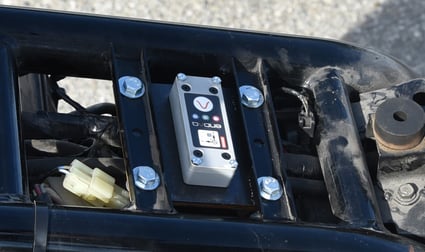
Because of the enDAQ sensor's portability and compact size, sensors were directly affixed to both the motorcycles and vehicles. The team installed enDAQ S4-R500D40 sensors near the center of gravity of three sport bike motorcycles, and S4-E25D40 sensors at the center of gravity of the three vehicles.
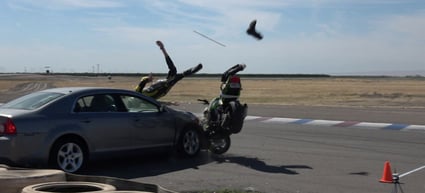
The sensors were strong and robust enough to survive the impact of a motorcycle crashing into a car at speed, reliably capturing data that accident reconstruction engineers had been unable to directly measure before. Three motorcycle-to-car crash tests were performed, each with a dummy in full gear weighing approximately 200 pounds colliding with the front right corner of a passenger vehicle:
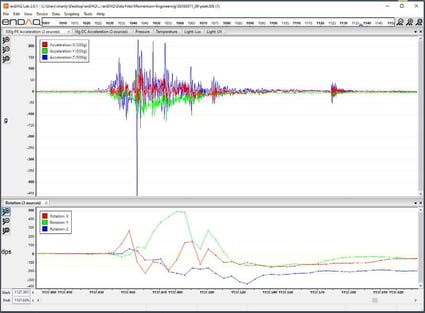
With two triaxial accelerometers (piezoresistive and variable capacitance) plus a gyroscope on each enDAQ device, MEC measured multiple crash parameters simultaneously. The 5th-order Bessel filter built into the enDAQ sensor was applied, with the cutoff frequency set to 1/5th of the sample rate.

| Metric | Kawasaki vs. Malibu | Yamaha vs. Focus | Kawasaki vs. Sentra |
|---|---|---|---|
| Motorcycle ΔV Resultant (mph) | 37 | 38.9 | 38.8 |
| Pulse Duration (seconds) | 0.073 | 0.094 | 0.145 |
Additional key metrics recorded across the tests included a velocity change of approximately 37 mph (650 in/s), a ΔV pulse duration of around 0.1 second, and peak acceleration levels of approximately 500g. The study established that the actual impact severity measured by the enDAQ sensor consistently fell between the full-dummy-mass and half-dummy-mass EDR predictions, providing a validated framework for future motorcycle crash reconstruction.
An Event Data Recorder (EDR) captures vehicle data such as speed, braking, and acceleration when an airbag deploys. This data is used by accident reconstructionists to calculate the forces involved in a crash and estimate pre-impact speeds.
The rider's mass becomes part of the momentum exchange during a crash. Whether the full rider mass or a partial mass should be applied when calculating motorcycle ΔV from vehicle EDR data had not been definitively determined—MEC's research provides the first direct validation of this relationship.
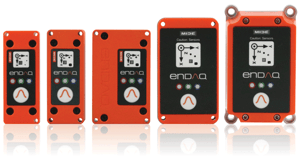
enDAQ sensors are ruggedized for harsh environments and high-shock applications. The S4-R500D40 model used on the motorcycles is specifically designed for high-g shock events, making it suited for direct crash testing applications.
The team used the 5th-order Bessel filter built into the enDAQ sensor, with the cutoff frequency set to 1/5th of the sample rate. Additional analysis was performed using the filtering tools in enDAQ Lab software.
Yes. enDAQ sensors have been applied across a wide range of crash testing scenarios, including bicycle braking, vehicle impacts, and aerospace shock testing, thanks to their configurable sensor range, multiple accelerometer types, and compact form factor.